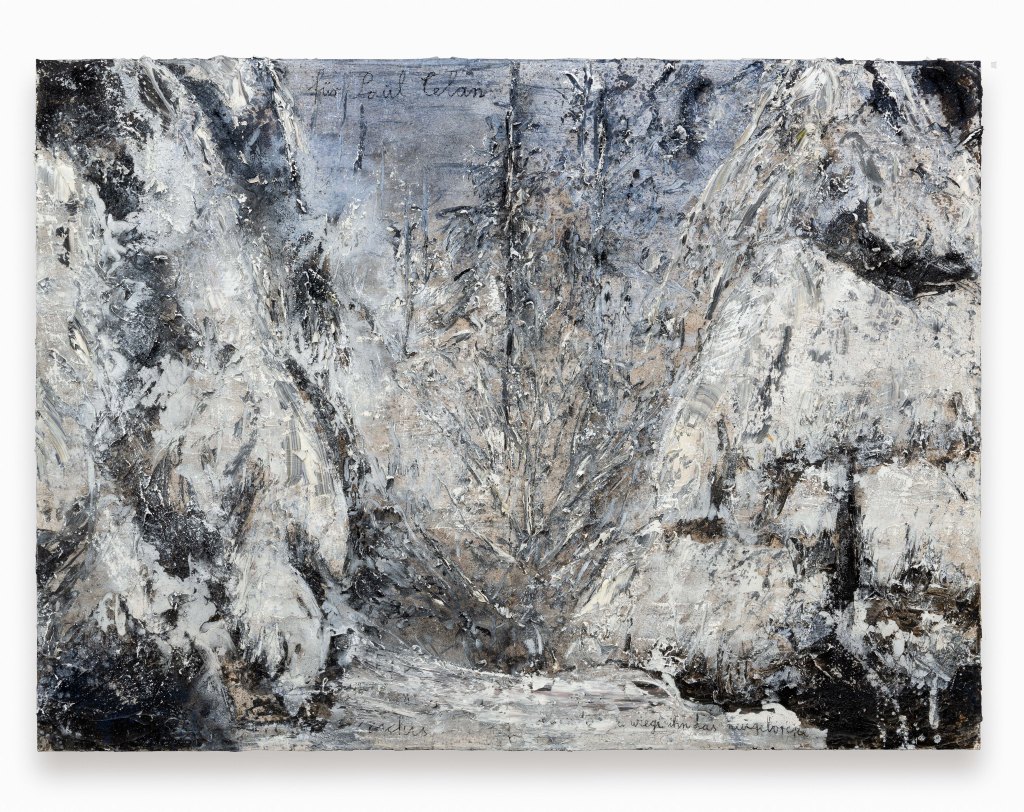
Anselm Kiefer, für Paul Celan, 2014–2021
Emulsion, acrylic, oil, shellac, porcelain, metal wire, coal, and chalk on canvas
280 x 380 cm (110.24 x 149.61 in)
© Anselm Kiefer. Photo: Courtesy of Thaddaeus Ropac Gallery
By Ed Schad
As people, later in life, begin to mourn the lives they were never able to live, common laments involve time and undeveloped talents, misplaced priorities, and lack of attention to what could have been the great loves of one’s life. I personally mourn a never achieved facility with languages. I just can’t do it; I cannot seem to gain any sort of ease and depth in my study of other tongues. As someone who writes poetry, it has been trying to see the penetrating depth of sound and sympathy that other writers are capable of, how they can take in the breath of others and make it stay.
I feel my lack of talent acutely when I read accounts of Paul Celan and the German language, how in the wake of World War II, the poet felt the root and ethic of the language carrying immense burdens, ruptures, and traumas, how the organization of external stimuli into German sounds could not escape those horrible histories and their ongoing stain. I can only stare at his poems through the wet glass of translation. I am unable to access Celan through the complexities of German, as Shoshana Olidort put it, “his mother tongue and also the language of his mother’s murderers.”
The death of his mother, shot and killed in a concentration camp for not being able to work, is the wound which makes German impossible for Celan. The event is so cataclysmic that — even in translation — words carry his mother and what happened from poem to poem across Celan’s entire career. Once Celan considered following his mother in death, sinking in “snows of the Ukraine,” it seems all snow in his poetry is the snow into which his mother fell. The word itself — Schnee — is forever linked to the murder, and Celan goes onto to implicate further vocabulary until the entirety of the German language holds and perpetually generates the wound:
Aspen tree, your leaves glance white into the dark.
My mother’s hair never turned white.”
Celan feels his mother in the passing of the seasons, as autumn turns cold forever:
Autumn bled all away, Mother, snow burned me through:
I sought out my heart so it might weep, I found – oh the summer’s
breath,
it was like you.
Then came my tears. I wove the shawl.
It is impossible to not be moved to tears by the idea of one’s very words — one’s physical sense of communication which turns air and breath into meaning — as being torn apart from within by the actions of others and only transmitting in repetition of pain. Celan’s poetry is a profound act of love, a love of his mother that touches the very fabric of how the world appears, of how language comes to be as shaped by self, by world, and, terribly, by societies and politics and war and hatred.
I have been thinking of this aspect of Celan as I have been trying to figure out the power of Anselm Kiefer’s painting für Paul Celan, 2014–2021. It is one of many dedicated to the poet, and like most of Celan works, a frigid landscape carries the tone. The horizon line is low and tight, and the eye hurdles towards what must be the very body of winter. On either side of a frozen canyon, snow saturates trees to the point of turning them to stone. The canyon terminates into further forest; at the painting’s center, a leafless tree, a black Lucio Fontana’esque rip in space, as spindly and grotesque as a suture.
Kiefer’s paintings of the proposed Nazi victory buildings of Albert Speer ghost their echo here. In the composition of the trees, I think of massive columns and walls spayed outward to the edges of the canvas, sweeps of floor propelling to a triangular point, and soaring ceilings. Down the center line of those paintings, Kiefer has placed fires, snakes, and the shades and shadows of individuals. In other paintings using strict one point perspective, he has laced his receding lines with the plow rows of empty fields, hatch marks of black stakes, and train tracks.
The histories which burden these symbols map onto each other through the deployment of the compositions, in their movement from canvas to canvas, from sculpture to sculpture, held more and more sub-rosa. With Kiefer, one feels the march of time, the march and fall of empire, from Teutoburg Forest to Alaric to the Morgenthau Plan. And this is usually a monumental movement, until I find myself here, to sit with Celan and his mother, all that myth and its aftermath merely shaking the snow on the branches, filling the forest with implication, taking into paint what Celan tried to take in and, subsequently, silence in the German language.
And all of these details would be enough to produce a powerful painting, yet I insist on also feeling something perhaps irrational, something that is perhaps a mere figment of my imagination. I feel Kiefer channeling — of all people — Gustave Courbet to tell this story, another artist who repeated his compositions to make buried, larger points about his content. Yes, how the Source of the Loue is echoed in the Origin of the World, the beginning of the river and the beginning of life flickering back and forth, nature mapping onto nature. I feel both paintings in Kiefer’s Celan painting, in how the snow is handled, in how the bottom of the painting seems a rush of water like the Loue, now frozen. Here, in the Kiefer, there is Celan, there are Nazi buildings, there is snow, but it all accumulates — through an afterimage of Courbet — into the wound, into the womb of the poet’s mother, Celan’s very source, his home, his origin, his anchor in language, gone cold.
Ed Schad is a Los Angeles-based curator and writer for art and culture publications, as well as Curator and Publications Manager at The Broad museum in Los Angeles. In 2022 he curated a survey of William Kentridge: In Praise of Shadows, as well as edited and wrote the book to accompany the exhibition. He previously organized and produced catalogues for the large scale exhibitions Takashi Murakami: Stepping on the Tail of a Rainbow and Shirin Neshat: I Will Greet the Sun Again. Schad has contributed essays to many monographic artist catalogs. His first collection of poetry is Letters Apart, a collaboration with the painter Liat Yossifor, co-published in 2023 by University of La Verne and DoppelHouse Press.
 The Nomadic Journal