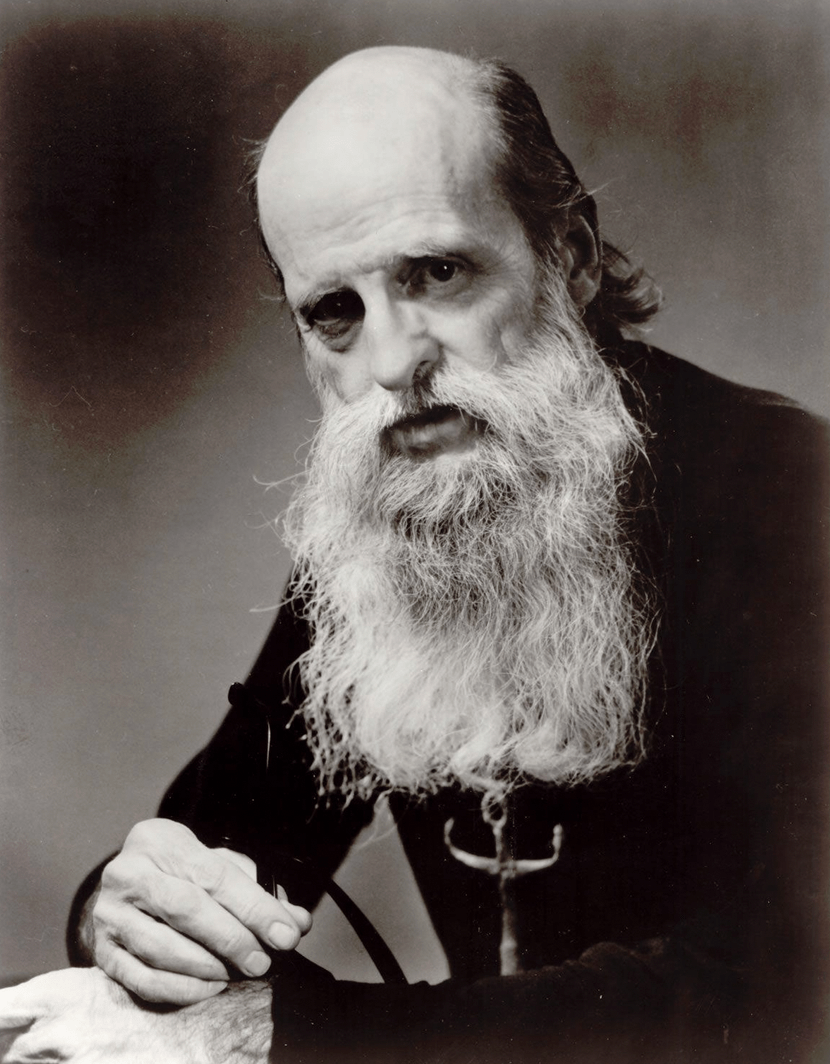
By Kathleen Spies, Ph.D.
Created primarily from 1966 to 1972, Norman Daly’s The Civilization of Llhuros was a complex, multimedia art installation at the forefront of the shift to many postmodern and contemporary art practices that mark the era’s most significant contributions – from institutional critique and viewer engagement to the artist-as-anthropologist and the use of found objects as indexical evidence.
Daly’s installation consisted of a faux archaeological exhibit of 135 art objects presented as artifacts of an invented ancient civilization named “Llhuros” combined with a dense interpretive framework of his own creation, which included the way he displayed the objects, the didactic labels, and a fifty-five-page catalog he designed and wrote in the guise of Cornell University’s “Director of Llhuroscian Studies” (figs. 1 and 2).1
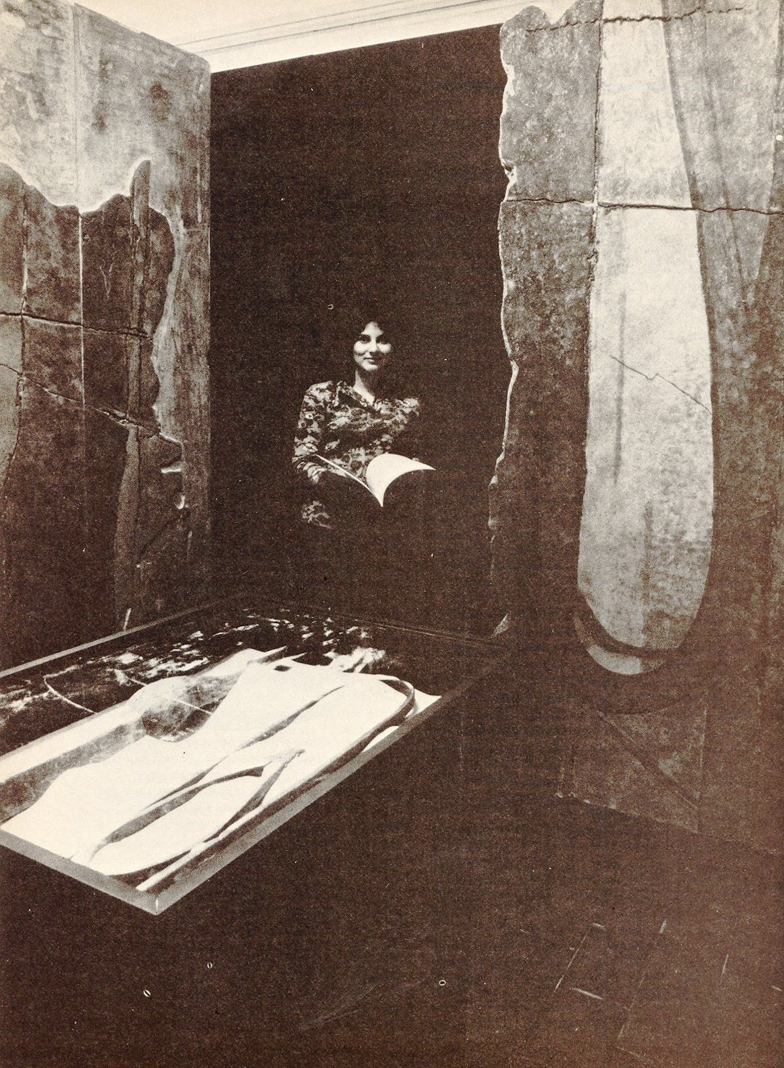
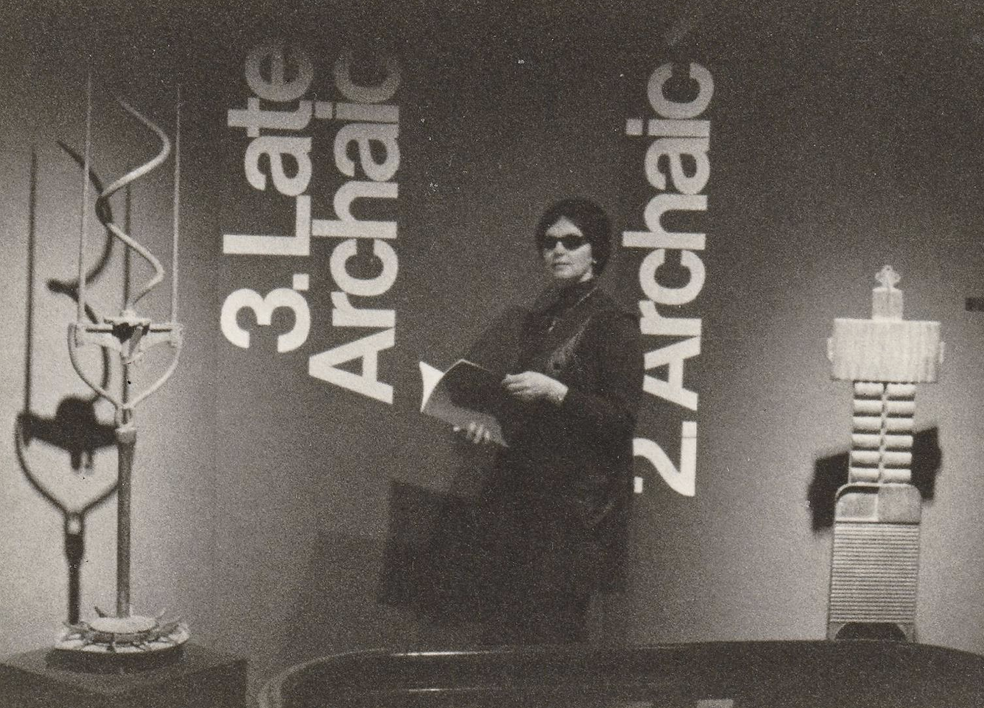
Completing this interpretive frame were three audio-visual components that ran on a loop within the galleries: a one-hour narrated slide show in which Daly posed as a Llhuroscian expert elucidating the import of the objects displayed; an audio re-enactment of a Llhuroscian religious procession with songs in “Llhuroscian” language; and a mock 28-minute radio interview onsite at a fictional archaeological dig with two supposed specialists in Llhuroscian Studies. The objects themselves, all created by Daly, were a mixture of original paintings, relief sculptures, assemblages and found objects. The found objects Daly used – often items of industrial and consumer waste such as old machine parts, Styrofoam packing material, and plastic trinkets – were alienated from their original function through assemblage, breakage, the application of actual sand and dirt, or painted trompe l’oeil patinas. Combined with his elaborate frame of interpretation and exhibition strategies such as organization, placement, and lighting, Daly transformed these humble objects into “temple wall fragments,” “votives,” and “devotional figures.” Bestowed with high intellectual and monetary value as precious rare specimens and evidence of a culture long past, some objects were shown in glass cases and all were arranged according to an elaborately detailed internal logic that traced the supposed rise, apex, and fall of this fictional civilization, for which Daly created its own set of symbols, language, deities, and rituals.
Llhuros was first exhibited in January 1972 at Cornell University’s Andrew Dickson White Museum. For the next two years it travelled to six other U.S. locations, including the Indianapolis Museum of Art and the University of Pennsylvania, and also abroad, most notably in Cologne, Germany’s “Projekt ’74.” This important 1974 exhibition brought together a set of international artists focused on concept-based faux-scientific installations, many of whom engaged in institutional critique, and appropriately exhibited Daly’s Llhuros alongside a select group of now canonical names, including Hans Haacke, Christian Boltanski, Vito Acconci, Nancy Graves, and more.2
Evidence suggests that Daly began working on Llhuros at roughly the same time and likely independent of knowledge of Marcel Broodthaers’ similar and now better-known Musée d’Art Moderne (1968–1972).3 In a 1971 interview, Daly stated that this was “the fifth year I have been working on the project,” placing its genesis in 1966 and confirming that he should be considered among those, like Broodthaers, at the forefront of the era’s bourgeoning institutional critique practices.4 For Daly, however, institutional critique was more intentionally tied to broader systems of knowledge, valuation, and authority than the artworld and art museum as “frame.” His barb at institutions was a means to an end, a side component of his aim to destabilize viewer response and engage the viewer in a more immediate way. Llhuros also had a far more detailed and extensive internal logic and interpretive framework than other similar works of the era, promising to bring new dimensions to our understanding of early institutional critique and early postmodern art practices more broadly.
Though Daly was a successful artist who regularly exhibited in notable shows from the 1940s through the 1980s, he is now largely unknown – unduly so – to most artworld professionals.5 Born in 1911 in Pittsburgh, he received a BFA from the University of Colorado and an MA in art history from Ohio State University. After a one-year fellowship in Paris, he completed additional graduate coursework in art history at New York University and exhibited at prominent New York galleries throughout the 1940s and early ’50s. He was selected for the Whitney Annual in 1947, ’48, and ’50, exhibiting alongside well-known artists such as De Kooning, Pollock, and O’Keeffe, and showed in a Betty Parsons-curated exhibition at Mortimer Brandt Gallery, at the Durand-Ruel and Bertha Schaeffer galleries, and at the Carnegie, where his then surrealist-expressionist paintings seamlessly melded with the neighboring works by Roberto Matta and Philip Guston.
Daly taught art and art history and worked as a guest curator at several institutions before moving to Ithaca in 1942 to join the art faculty at Cornell, where he taught for the remainder of his career. In the mid-1960s, he embarked on a major transition in his art, moving away from his emphasis on formal experimentation and paintings of abstracted, Southwest-inspired imagery and toward a greater conceptual emphasis on three-dimensional sculptures, reliefs, installation and assemblage, resulting in the creation of The Civilization of Llhuros.
For Llhuros, Daly built not just a fictional civilization and its internal logic, but the entire frame of interpretation with a whole cast of fictional experts with impressive titles who quote and cite each other in an absurd, self-serving loop. As he later explained, “[I] go beyond the boundaries of a conventional exhibition…in various ways… [I] parody the analytical methods of anthropologists, sociologists, psychiatrists, and art historians. I challenge the reliability of the viewer’s own senses by creating ambiguity – by using real stone, marble and metal along with carefully patinated Styrofoam, plastic and found objects to suggest an ancient origin. I emphasize deception, obscurities and satire.”6
Daly’s very organization of the 135 art objects into three distinct periods – Archaic, Middle, and Decline (fig. 2) – which he expounded upon in the catalog, mimics and mocks traditional art historical and archaeological strategies for organizing works according to a rise-apex-fall model, which confers preconceived value and meaning to them accordingly. Seen in the treatment of Ancient Greece (divided into Archaic, Classical, and Hellenistic periods) or of the Renaissance, Daly would have been well aware of such conventions given his formal background in the history of art. The attributes he assigned to each phase likewise parodies traditional scholarship: the early phase of the movement when characteristics in form, iconography, and concept are in their nascent phases, a phase that lacks in technical skill and training but is venerated for its authentic, immediate and more “primitive” abstract forms; a high phase where form, subject and concept reach a mature sophistication, in which technical skills are perfected and buttressed by a bustling economy; and a late phase or decline, in which technical virtuosity is overabundant and imitative styles are thought to reflect the lack of morality and deceptions of the broader society.
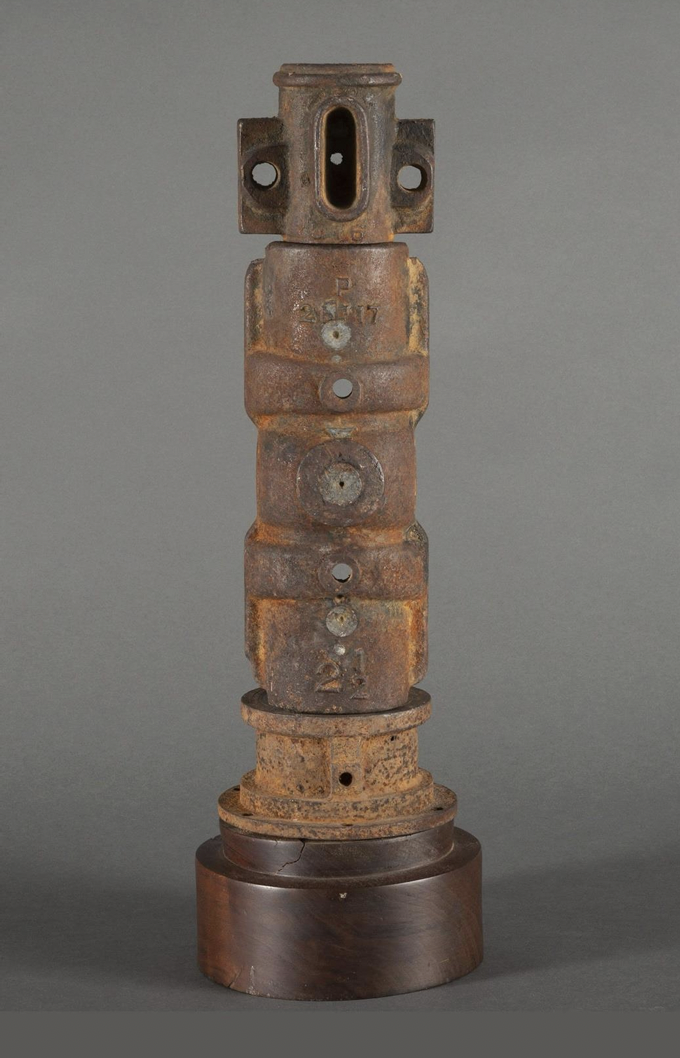
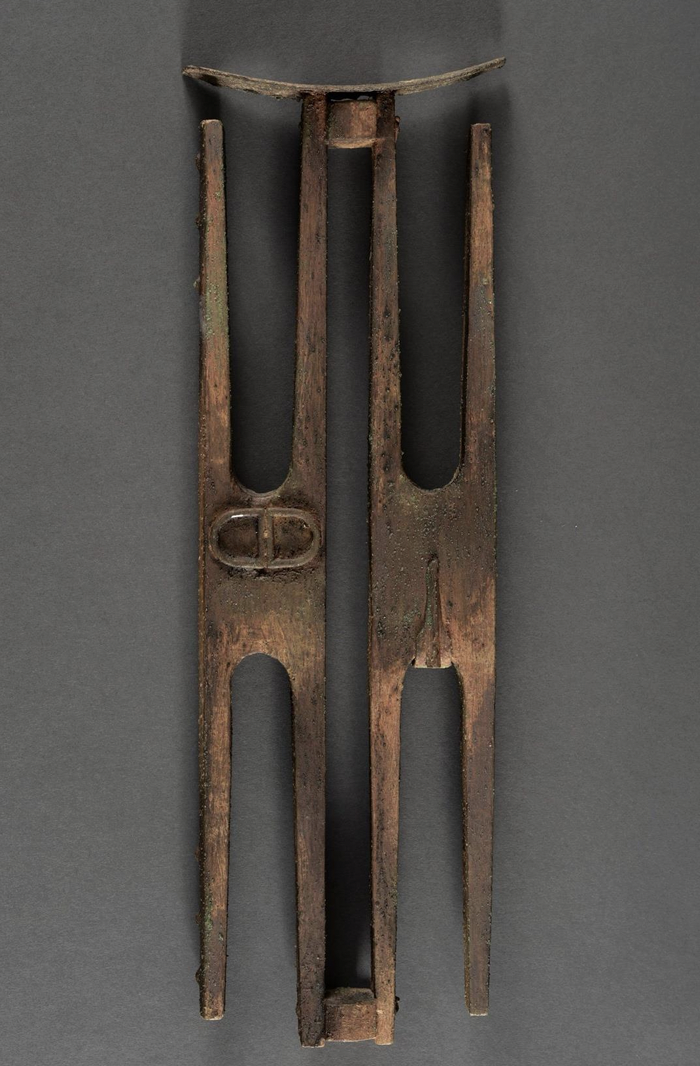
Such overarching concepts guided Daly’s curatorial, aesthetic, and material choices regarding the specific objects he placed in each period, and ultimately infer that his intent was about more than institutional critique alone. In the Archaic period, he placed objects that are mostly abstract, as in #5: Votive Figure and #21: Pair of Stilt-Walkers (Devout Couple), and that merely suggest the anthropomorphic, such as an upright figure with hands clasped in prayer (figs. 3 and 4). Their actual and fictive medium are one and the same – here metal and wood, in other Archaic pieces stone – materials with presence, tactility, and weight. Their simplified form and rough-hewn quality give them a material, palpable presence and elemental beauty, augmented by their patina, which is often real rust, algae or dirt.7
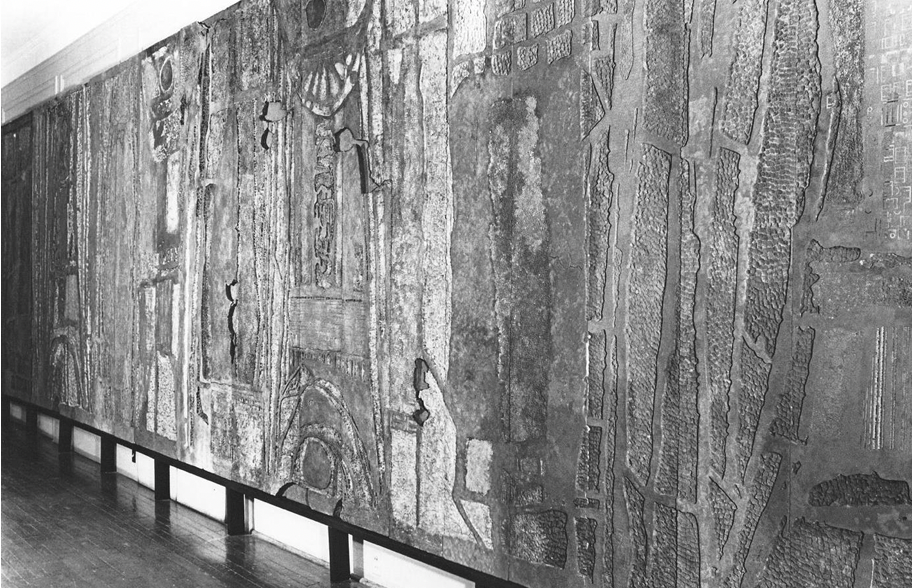
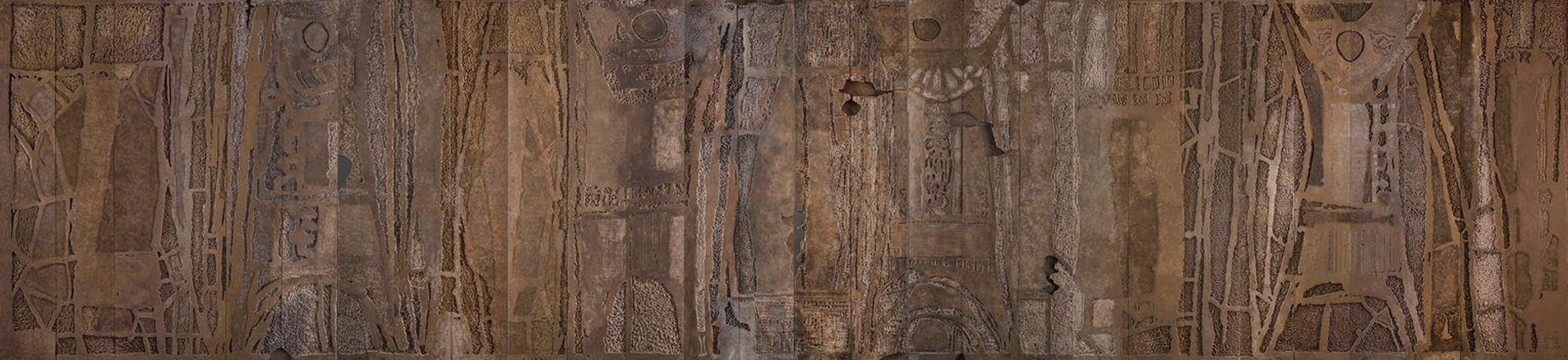
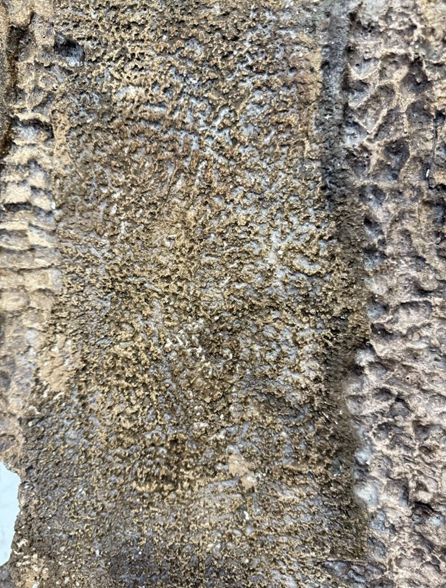
In the Middle Period, Daly placed works that show an advanced technical skill and a grand scale suggestive of the supposed wealth, growth, and sophistication of the society at large. The monumental 9’ x 37’ #85: Inner Wall Section from the Temple of Phallos (fig. 5 a, b, c) is impressive in scale and exquisitely constructed. While the actual material is Styrofoam and not stone as described in the catalog, it looks as if it is. Painted in subtle earthen ochres, rusts and browns, with stippled carving that mimics the imperfect, unique markings of nature as opposed to the standardized work of a machine, the sheer technical skill lures the viewer into its fictive world. Other period works show linear perspective and modeling, giving visual support to the more “advanced” nature of this society (#71).8
In the Decline Period, Daly constructed or placed countless small-scale decorative objects that show a flourish of naturalistic technique and mimicking of surface detail, as in the convincing musculature and movement in #119 Duocorn and Calf (fig. 6).
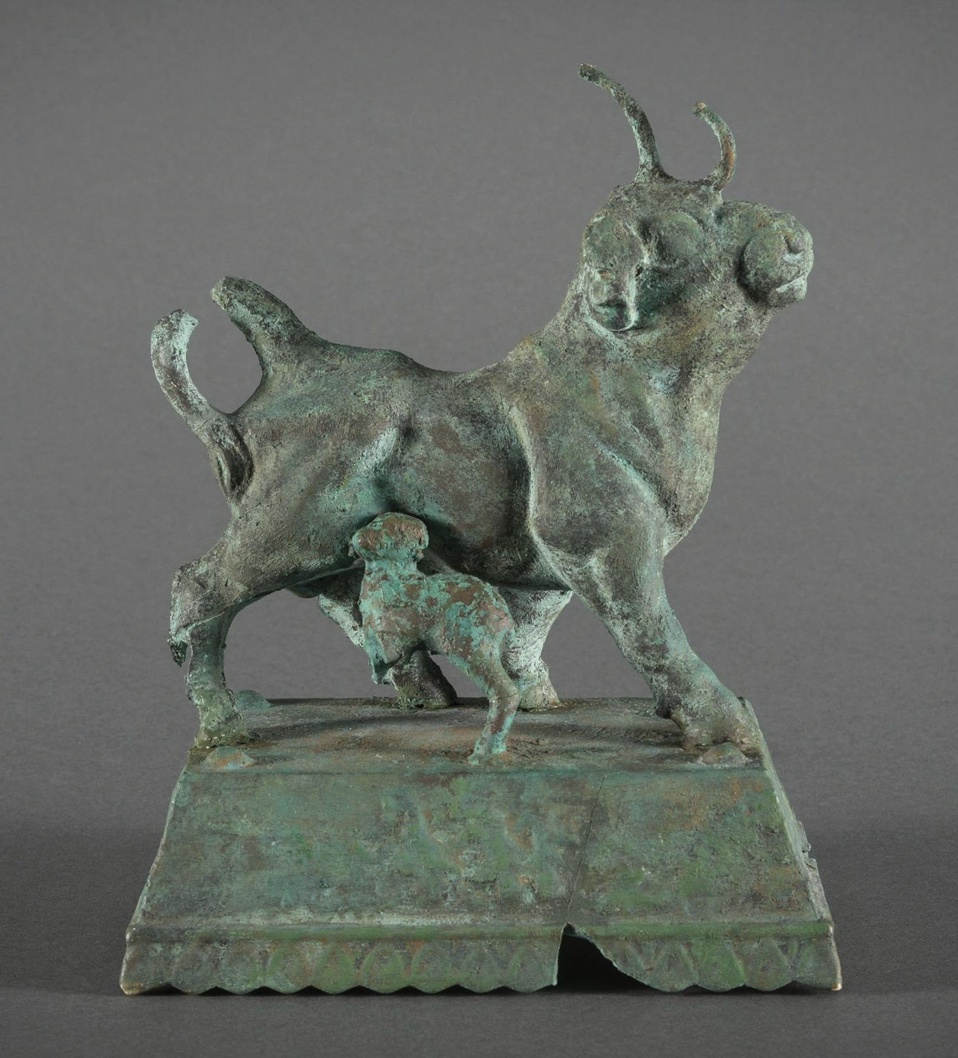
The function of all this artistic achievement, however, is pure show; we are told they are objets de luxe for the selfish adornment of corrupt leaders and their indulgent displays of wealth and power. #110 Doors from the Villa at Atraxos (fig. 7) are from a private casino as opposed to a religious temple as in the Middle Period (#85, fig. 5) and an extravagant flamingo-like tchotchke holds gambling dice (#112). Other ornate items hold “aphrodisiac powders” (#129) or are devices to control the minds of ordinary citizens in a complex game for the powerful (#132).
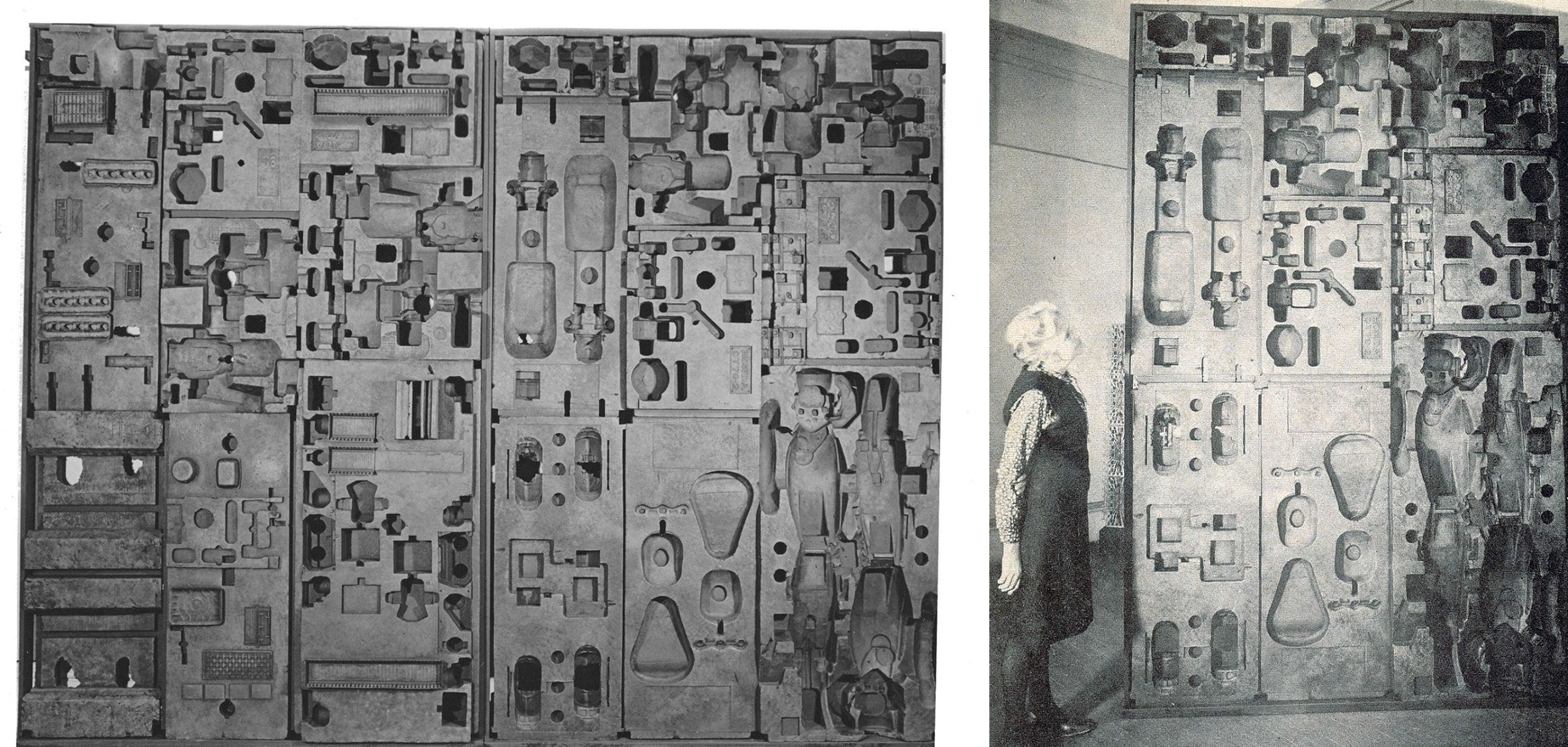
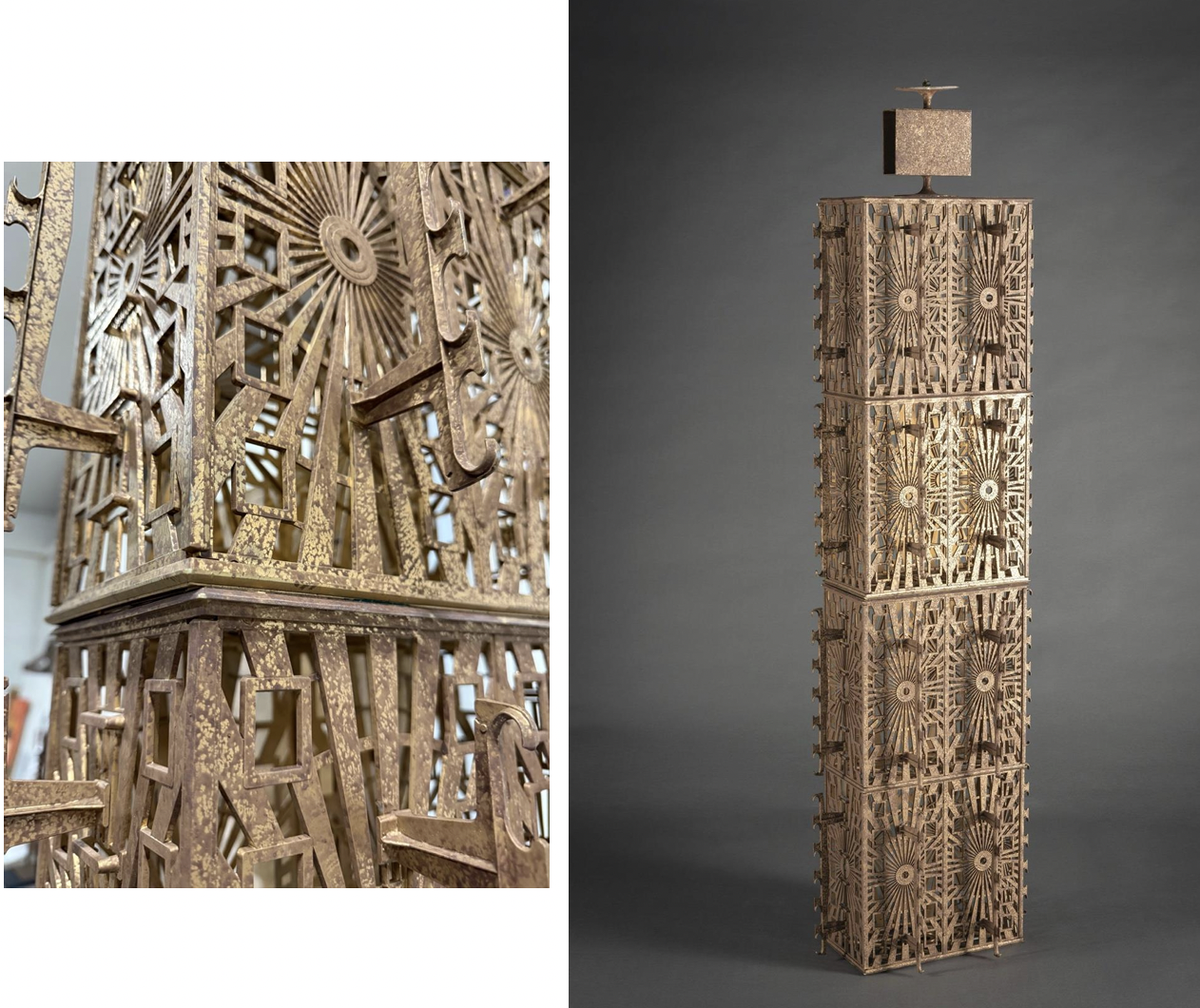
It is in the Decline period that Daly placed the most prominent fissures in his elaborate narrative. Decline objects’ actual and fictive mediums are often different and often visibly so, resulting in an overall feeling of deception or falsehood and a disjuncture between what viewers see in front of them and what the supposed authoritative voices in the catalog and museum display are telling them. The found objects Daly used in this period – small plastic kitschy knick-knacks, Styrofoam packing, food containers – are the throw-away items of late capitalist consumer culture – actual trash in another context. The overall feeling of the objects themselves is cheap, suggesting that this use of refuse was every bit Daly’s intention. The intentionally deskilled “bronze” #110: Doors, for example, are simply a collection of largely unaltered Styrofoam packing crates with unchanged impressions and voids where mechanical parts were, painted uniformly and stacked very high and wide (fig. 7). “Honda” logos appear in at least two areas and he made no effort to eliminate them. Similarly, while in reproduction #123 Votive appears masterful filigreed metalwork, in original one quickly ascertains that the individual components are too perfect and are the flimsy, plastic work of mass production (fig. 8).
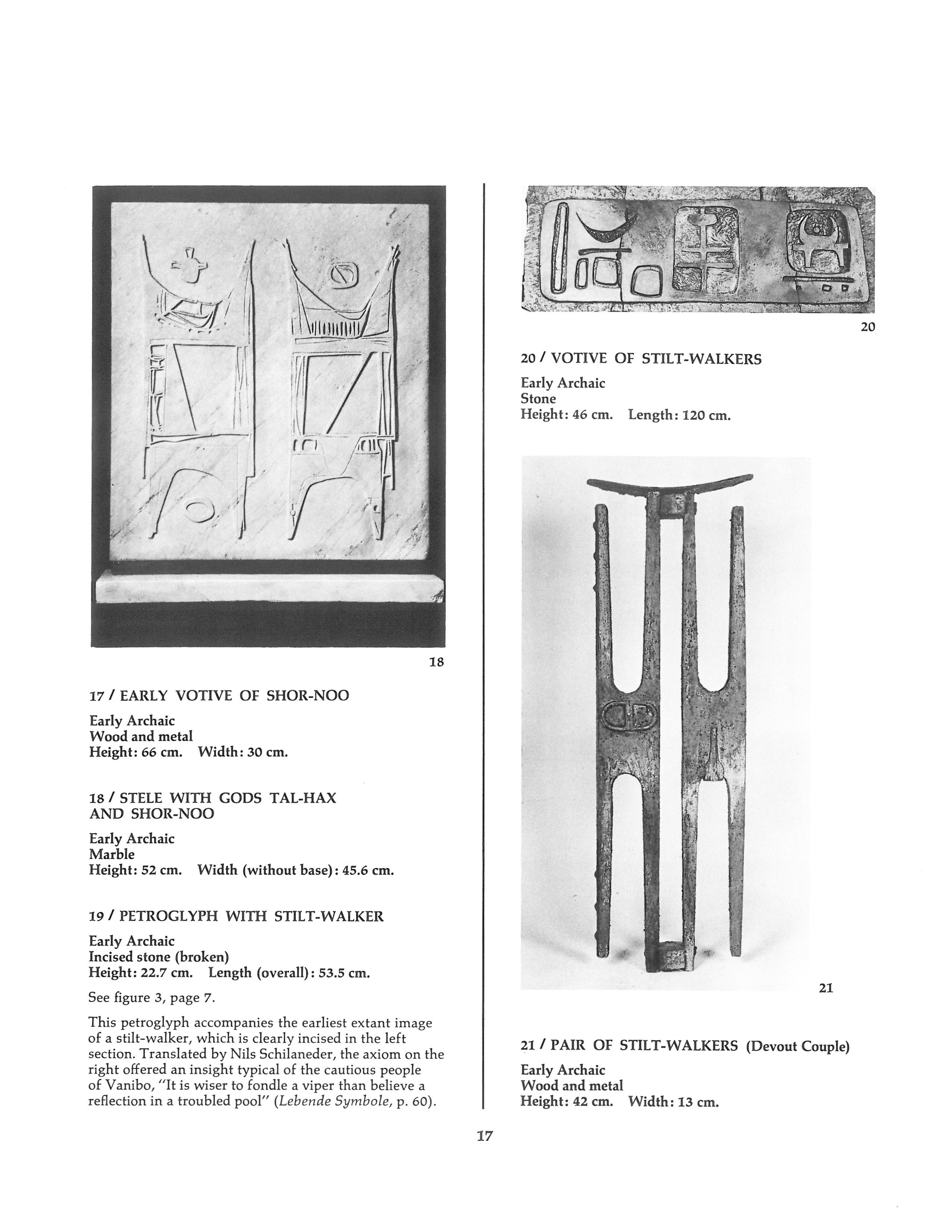
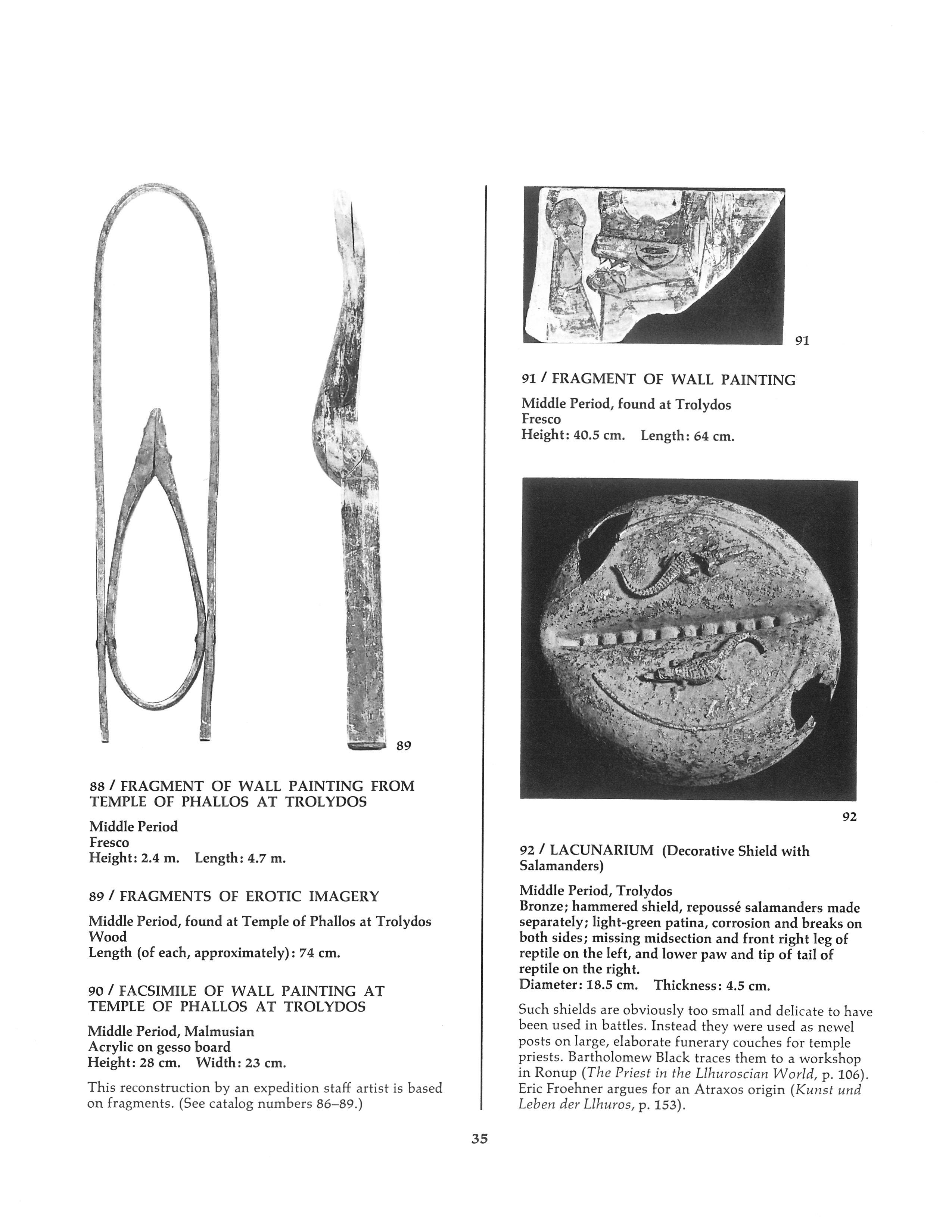
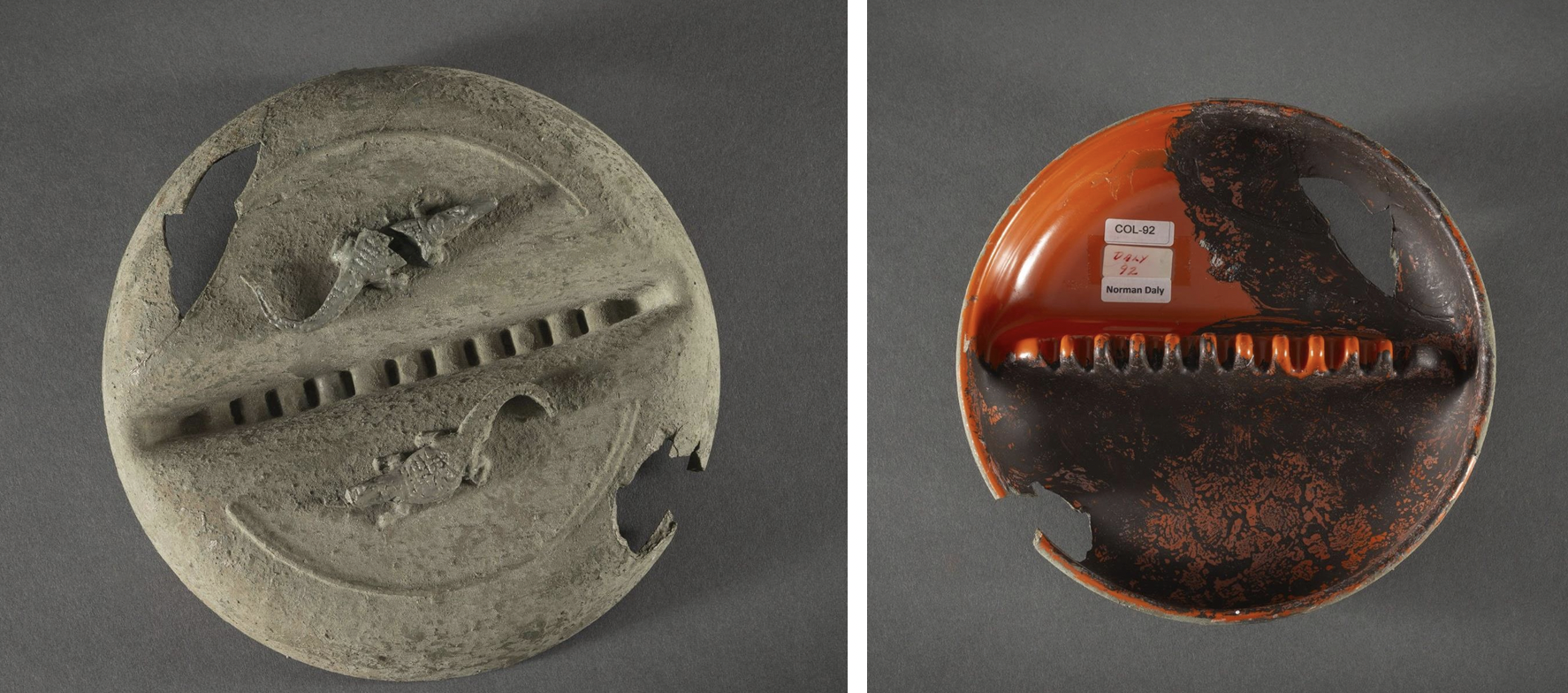
Likewise, in the catalog Daly continues to “parody analytical methods” and “creat[e] ambiguity” between fiction and fact. He presents the objects not as artworks, with quality, large color photographs and limited text, but as archaeological artifacts, with all 135 objects listed in order and only some reproduced in small, grainy black and white images. Using a documentary, categorical approach with the mock objectivity of a scientist, each item is numbered and given a descriptive title and identifying information, with all but the scale being fictional (fig. 9). Some objects have additional explanation, translated “Llhuroscian” poems, or summaries of fictional scholarly debates.9 The entry for #92 (figs. 10 and 11), in actuality an orange plastic ashtray and toy alligators reassembled and patinaed, is typical:
92 / Lacunarium (Decorative Shield with Salamanders)
Middle Period, Trolydos
Bronze: hammered shield, repoussé salamanders made separately; light-green patina, corrosion and breaks on both sides; missing midsection and front right leg of reptile on the left, and lower paw and tip of tail of reptile on the right.
Diameter 18.5 cm Thickness: 4.5 cm
Such shields are obviously too small and delicate to have been used in battles. Instead they were used as newel posts on large, elaborate funerary couches for temple priests. Bartholomew Black traces them to a workshop in Ronup (The Priest in the Llhuroscian World, p. 106). Eric Froehner argues for an Atraxos origin (Kunst und Leben der Llhuros, p. 153).
This listing of objects is preceded by a dense, 10-page mock essay penned by Daly as “Director of Llhuroscian Studies” rather than “Professor of Art.” The essay details the internal logic of Llhuros and its periods, with all the trappings of academic speak but in absurd and ridiculous excess. He copiously cites primary and secondary texts and uses unnecessarily complicated, jargon-laden prose, long-winded explanations, and lengthy quotations and footnotes. Daly’s overly verbose circular logic reaches an added height of absurdity and silliness with the “Selected Bibliography,” replete with an array of impressive titles in multiple languages that specialize in Llhuros’ minutiae.
Daly’s slippage between fact and fiction and dadaist use of humor and parody as a form of conceptual critique is maintained in Llhuros’ audio-visual material, as during the mock radio interview when “Dr. Nils Schilaneder” (played by a Cornell colleague) switches from a Swedish to an British accent, or when the host, thinking the taping has ended, grumpily mumbles about having to appease program sponsors. In both the catalog and these audio-visual materials, there is clearly also an element of performance art. In the early ’70s, in a particular Duchampian turn, Daly even dressed and posed in character as a Lhuroscian priest for photographs, openings, and once even during a flight to Greece, wearing a rare “Lhuroscian” pendant that was really patinaed plastic (fig. 12).10
As Daly reflected on his project, “All these components are aimed at stimulating audience involvement…. Provocations, deceits and even frustrations are employed as activating forces which urge, if not to goad the viewer to wonder, question, consider and perhaps participate in a creative response.”11 Utilizing the viewer destabilization practices common to institutional critique, Daly aimed to “create ambiguity” with some objects more, and some less, believable as items of antiquity. Viewers alternately question their own perception and the supposed authority of the discursive frame. So thorough and detailed is Daly’s constructed frame of interpretation that the viewer is often inclined to overlook subtle telltale signs of a much later era (serial numbers, too-perfect regularity indicating mechanical reproduction) until too obvious to ignore. Intentionally playing with viewers’ sense of veracity, Daly’s installation rewards and encourages careful viewing, engagement with objects, and critical thinking over passive acceptance of what one is being told. We are encouraged to engage in prolonged observation, to carefully read and not carelessly skim the catalog.
For the engaged viewer and reader that does so, Llhuros’ farce leads to broader cultural observations. As he explained in the “Projekt ’74” catalog: “At first sight the spectator’s desire for ages long past, for lost cultures with their finds and legends is satisfied, at second sight the spectators realize that Llhuros is nothing more than a reflection of their own age with its psychological problems and obsessions.”12 As it becomes increasingly clear to the careful observer that the objects are those of our own era of excessive consumerism and misuse of power, so too does the careful reader of the catalog detect clues that Llhuros is us. As the last line of the essay reveals, the real issue is “the traumatic reflection of ourselves in this narrow spectrum of Llhuroscian life” (14). The “apathy of staggering proportions,” “absolute collapse of ethics,” and “obsessive pursuit of sensory excitation” that supposedly precedes Llhuros’ decline is uncovered as that of our own society (14).
Given that it was created in an era of broad cultural questioning of institutional authority and systems of power, embodied in the era’s Vietnam, Civil Rights, and feminist protests, Daly’s barb at contemporary culture and institutional “truths” seems fitting. Like Thomas Cole over a century before, he rang a warning signal to viewers, one which we might still heed today.13
Fifty-plus years after its creation, the legacy of The Civilization of Llhuros looms large and long. It can rightly be viewed as a precursor to more recent contemporary art trends – not only ongoing institutional critique in the works of artists such as Fred Wilson, Mark Dion, Andrea Fraser, and more, but also in the impulse of utilizing curatorial practices, documentary or scientific vision, and faux-exhibition strategies or what has been recently also called “fictive art,”14 and in looking at history as memory, as flawed and subjective. This poststructuralist critique shines a bright light on the institutionalized construction of knowledge, meaning, and value to which artworks and archaeological objects alike are subject, and how this “frame” or apparatus – the physical and discursive context in which objects are viewed – has historically dictated viewer experience, prompting viewers instead to, in Daly’s words, “participate in a creative response.”
All extant objects of Llhuros have recently been acquired by Cornell’s Anthropology Collaboratory, where it can be viewed in its entirety. Related material may be found in the Norman Daly Papers, recently acquired by Cornell University’s Division of Rare and Manuscript Collections. Digital reproductions of many primary and secondary sources, along with quality reproductions of Daly’s work, also can be viewed at normandalyart.org and civilizationofllhuros.org.

Kathleen Spies is Professor Emerita of Art History, Birmingham-Southern College, and a specialist in modern, American, and contemporary art. A former Smithsonian fellow, her publications on Thomas Eakins and nervous illness, on Reginald Marsh, burlesque and humor, and on Walt Kuhn’s proto-pop aesthetics have appeared in American Art, Nineteenth-Century Studies, Journal of American Culture and elsewhere. She currently teaches art history at the University of Alabama.
- After 1972, Daly completed an additional 15 objects, bringing the total to 150.
↩︎ - Llhuros occupied the entire first floor of Cologne’s Romisch-Germanisches Museum and Daly created several new Llhuroscian objects just for the space. According to Ken Evett, “Daly’s exhibition was carefully calculated to exploit the juxtaposition of the museum’s authentic Roman archaeological remains and the fake antiquities of his own imaginary civilization.” See Evett, “Kunst Bleibt Kunst: Projekt ’74,” The New Republic (1974) 4.
↩︎ - Broodthaers’ installation was first exhibited in a nascent stage in the artist’s apartment in 1968 and only in 1970 in a public museum space. Its first exhibition in the U.S. was not until 1977. Allan Kaprow’s Happening Household was performed at Cornell in 1964, but it is unknown whether it affected the mid-60s shift in Daly’s art. ↩︎
- Installation photos of his 1965 A.D. White exhibit of paintings and assemblages, many of which were later adopted into Llhuros, show that he was already thinking of these individual artworks as a kind of Gesamtkunstwerk installation organized around broader conceptual themes. Box 3, Folder 2, Norman Daly Papers, Division of Rare and Manuscript Collections, Cornell University Library, Ithaca, NY. ↩︎
- This is partly due to the large-scale, multi-object nature of Llhuros which makes it impractical for museum collection, its ephemeral installation and time-based elements which are difficult to fully recover, and the fact that most objects had until recently been hidden from public view in storage or private collections. ↩︎
- Norman Daly, “Background of Civilization of Llhuros,” presentation at the College Art Association Annual Conference, 1988. Box 1, Folder 11, Norman Daly Papers, Division of Rare and Manuscript Collections, Cornell University Library, Ithaca, NY. Reproduced at http://www.civilizationofllhuros.org. ↩︎
- Daly also relocated many of his metal assemblage “Constructions” from the early 1960s to this Archaic period. That the found objects of these assemblages are often parts of antique furniture or now defunct machine parts augments their alienation for the viewer and their believability as items of antiquity. ↩︎
- See, for example, the “facsimile” of a Llhuroscian fresco such as #71, civilizationofllhuros.org. ↩︎
- The fiction of the catalog is only fully broken at the end, where the reader finds the 1971 interview between Daly, now identified as “Professor of Art” and Thomas Leavitt, then director of the A. D. White Museum. ↩︎
- Linda Fisher, Norman Daly Art, to author, June 15, 2026. ↩︎
- Daly, Panelist Summary for “Artists’ Visions of Imaginary Cultures,” session, College Art Association, 1988. Box 1, Folder 11, Norman Daly Papers, Division of Rare and Manuscript Collections, Cornell University Library, Ithaca, NY. ↩︎
- Daly quoted in Evelyn Weiss, “The Rediscovered Time,” Projekt ’74: Aspects of International Art in the 1970s (Cologne: Kunsthalle, 1974) 14. ↩︎
- That Llhuros was included in the 2019 Istanbul Biennial “The Seventh Continent” confirms its continued relevance, linking it to our current culture of waste and environmental concerns that give a new dimension to Daly’s earlier observations. ↩︎
- For a book-length study on “fictive art,” which rightly discusses Daly as a pioneer, see Antoinette LaFarge, Sting in the Tale: Art, Hoax, and Provocation (Los Angeles: DoppelHouse Press, 2021). ↩︎

